

Steel Bulk Freighter
Built: 1903, American Shipbuilding Company, Cleveland, Ohio
Length: 380 feet
Lost: November 11, 1940
Discovery: 1940-41 by fisherman Clyde Cross
Location: Bow—N 43° 45.784′, W 086° 27.776′; Stern—N 43° 45.705′, W 086° 27.849′, approximately 1.5 miles south of Pentwater, Michigan, 35–45 feet|
Depth: 35 feet
HISTORY OF THE SHIP
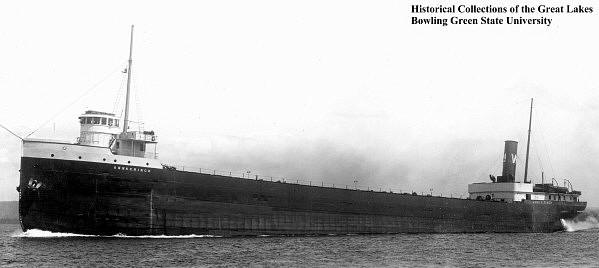
The Anna C. Minch was a 380-foot steel bulk freighter built in 1903 by the American Shipbuilding Company in Cleveland, Ohio. Constructed as Hull No. 415, the vessel represented the standard Great Lakes bulk-carrier design of the early twentieth century. It measured 50 feet across the beam and had a molded depth of 28 feet. A triple-expansion steam engine powered the vessel, producing approximately 1,300 to 1,460 horsepower.
The vessel entered service under the ownership of the Kinsman Transit Company of Cleveland. In 1914, workers rebuilt its cargo hold using arch construction, replacing the traditional support pillars and increasing the efficiency of the cargo spaces. The Anna C. Minch subsequently carried a variety of bulk cargoes throughout the Great Lakes.
The vessel changed hands in 1926, when the Western Navigation Company of Fort William, Ontario, acquired it. Its Canadian registration listed the ship at 387.1 feet in length, 50.2 feet in breadth, 23.9 feet in molded depth, with a gross tonnage of 4,139 and a net tonnage of 2,880 tons.
The ship took its name from Anna C. Minch, wife of Philip Jacob Minch, whose family became prominent in Great Lakes shipping. The Minch family and its associated companies played an important role in the development of the Great Lakes bulk-carrier trade.
The Anna C. Minch had already survived several mishaps during its career, including a grounding on Fox Point in Lake Michigan in December 1925 while carrying coal to Milwaukee. The vessel was refloated without loss of life and returned to service.
By 1940, the Anna C. Minch remained an active and seaworthy Great Lakes freighter despite being nearly four decades old. Its final voyage began at Fort William, Ontario, where the vessel loaded cargo for Chicago. The Canadian government’s subsequent investigation reported that the ship loaded refuse screenings at six elevators between November 7 and 8. Other accounts describe the cargo as bulk material associated with the grain trade. The vessel then departed for Chicago with Captain Donald Kennedy in command and a crew of 24.
THE SINKING
The Anna C. Minch disappeared during one of the most violent storms ever recorded on Lake Michigan. On November 11, 1940, a rapidly intensifying low-pressure system crossed the Midwest. A powerful cold front swept across Lake Michigan, abruptly shifting the wind and producing violent southwest gales. The storm generated enormous waves and blizzard conditions as temperatures plunged.
The Anna C. Minch was traveling southward along the western shore of Michigan, following a route also taken by the William B. Davock. The two freighters ultimately disappeared in the same storm, along with the Novadoc, which grounded near Pentwater. The three vessels accounted for 59 deaths on Lake Michigan.
The precise circumstances of the Anna C. Minch‘s final moments remain uncertain because no one aboard survived. The Canadian government’s investigation concluded that the ship probably encountered the worst of the storm during the night of November 11–12. Investigators noted that the vessel’s high forward superstructure and its loading condition would have made it difficult to turn into the rapidly shifting southwest wind.
The ship apparently suffered catastrophic structural damage as the waves increased. When rescuers eventually examined the wreck, they found a large opening in the port side and evidence that the hull had been violently forced apart. The investigation recorded a gash approximately 20 feet wide extending from the deck toward the bilge, together with additional structural damage farther aft. Deck beams had been forced upward, and steel hatch covers lay scattered across the lake bottom.
The evidence indicates that the Anna C. Minch broke in two as it foundered. The bow and stern came to rest separately in shallow water, roughly 600 feet apart. The vessel’s pilothouse, forward superstructure, masts, and smokestack were swept away during the disaster.
For years, historians considered the possibility that the Anna C. Minch and William B. Davock had collided during the storm. The two ships disappeared in the same general area, and the large opening in the Minch‘s port side seemed to support the theory. When divers located the Davock in 1972, however, they found no evidence of collision damage on its hull. The evidence therefore favors a catastrophic structural failure caused by the storm rather than a collision between the two freighters.
All 24 members of the Anna C. Minch‘s crew perished. Bodies began washing ashore along the Michigan coastline shortly after the storm, providing the first physical evidence of the vessel’s fate.
The sinking formed part of the larger tragedy of the Armistice Day Storm. On Lake Michigan alone, the William B. Davock, Anna C. Minch, and Novadoc were lost, while several smaller vessels also disappeared or suffered serious damage. The storm claimed 59 lives from the three freighters and became one of the defining maritime disasters in Great Lakes history.
THE DISCOVERY OF THE WRECK
The location of the Anna C. Minch did not remain a mystery for long. On November 15, four days after the storm, Pentwater commercial fisherman Clyde Cross, master of the fishing tug Three Brothers, spotted a wind vane protruding from approximately 40 feet of water about 400 feet from shore, roughly 1½ miles south of the Pentwater breakwater.
Divers soon confirmed that the protruding structure belonged to the Anna C. Minch. They found the wreck upright in shallow water with the pilothouse and foremast missing. The vessel had broken apart, with approximately 100 feet of the stern separated from the forward section. Divers also documented a large opening in the port side.
The discovery provided investigators with the first opportunity to examine the physical evidence of the disaster. The Canadian inquiry, conducted in December 1940, documented the wreck and concluded that the available evidence could not establish the exact sequence of events leading to the sinking. Without survivors, investigators could only reconstruct the final voyage from the condition of the wreck, recovered bodies, weather information, and the movements of other vessels.
The discovery also revealed how dramatically the storm had damaged the vessel. The bow section lay close to shore, while the stern had separated from it. The exposed wind vane became a poignant symbol of the disaster and was later preserved as a maritime artifact.
In the spring of 1941, the U.S. Lake Survey of the Army Corps of Engineers examined the lake bottom in the region while searching for the wreck of the William B. Davock and determining whether submerged wreckage posed a hazard to navigation. The survey used a horizontal wire suspended at a predetermined depth and towed through the area to detect submerged obstructions.
The Anna C. Minch thus became one of the earliest Great Lakes wrecks to receive systematic attention from both government investigators and divers following its loss.
SURVEY DIVE BY MSRA
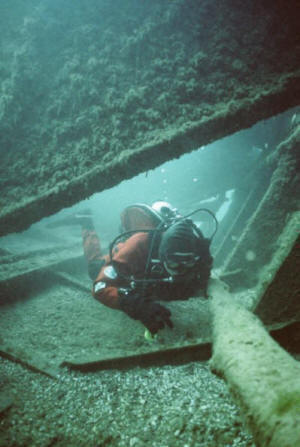
In October 2008, the Michigan Shipwreck Research Association conducted a detailed survey of the Anna C. Minch. MSRA documented both major sections of the vessel, which lie approximately one-tenth of a mile apart in 35 to 45 feet of water. The shallow location and decades of exposure to Lake Michigan’s waves and winter ice have left both sections heavily broken and flattened.
The stern section is smaller than the bow but retains some of the ship’s most recognizable machinery. Three Scotch boilers arranged side by side dominate the site. Their upper portions rise to within approximately 20 feet of the surface, making them visible from a dive boat on a clear, calm day.
The wreckage around the stern extends across an area approximately 60 feet in diameter, with the boilers forming its central feature. The triple-expansion engine and other machinery remain among the most significant surviving elements of the ship.
The larger bow section lies approximately 600 feet north of the stern. Its orientation differs from the expected alignment of the original vessel, suggesting that the section rotated as the ship broke apart and settled on the lake bottom. The bow points generally southeast.
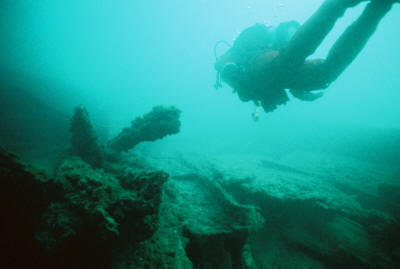
A large, detailed winch remains at the extreme forward end of the wreck. Moving aft, the starboard side of the hull has collapsed inward, exposing portions of the outer hull and internal structure.
Farther aft, a series of structural steel frames creates openings through which an experienced diver can view portions of the interior. These frames also provide a striking photographic record of the ship’s construction. Near the point where the vessel broke apart, the remaining structure gradually disappears into the sand.
The wreck has continued to deteriorate since its discovery. Waves, ice, currents, and the passage of more than eight decades have scattered and flattened portions of the hull. Yet substantial structural and mechanical components remain, allowing divers to reconstruct the scale and design of this once 380-foot Great Lakes freighter.
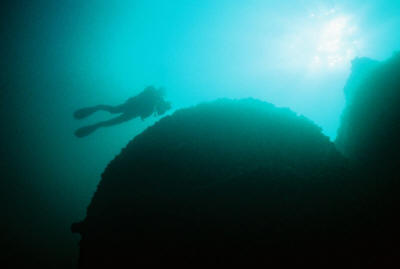
The two sections of the Anna C. Minch offer contrasting archaeological experiences. The larger bow preserves the vessel’s hull structure, forward machinery, and cargo-handling equipment, while the smaller stern provides an unusually accessible view of the boilers and surviving engineering spaces.
Today, the Anna C. Minch rests close to shore in remarkably shallow water, a site that belies the violence of the storm that destroyed the vessel. Its scattered remains, separated bow and stern, and surviving machinery provide tangible evidence of the catastrophic forces that swept across Lake Michigan on November 11, 1940—and of the 24 people who never returned home.